Skip to content

Delivery · trucks & site access

How the sand actually gets there.

Arena sand arrives by the truckload, roughly 18–22 tons at a time. Most arenas need several.

Nobody explains what that involves before a truck is in your driveway. So: which truck comes, how many loads, what the driver needs to reach you, and what to do the day before.

what arrives
Roughly 18–22 tons per load, several loads
what the truck needs
12 ft of width, 14 ft of overhead on the route
what it weighs
70,000–80,000 lbs fully loaded

The short answer

How bulk sand gets delivered.

Your sand arrives loose in a dump truck. Not bagged, not on pallets.

Each truck and trailer carries roughly 18–22 tons, so most arenas take several loads.

18–22
tons per load
65–70
ft of truck and trailer
12 / 14
ft wide / ft overhead
70–80k
lbs of loaded truck

The equipment

Which truck shows up.

Four kinds of truck haul bulk sand. Which one arrives depends on your tonnage and how tight your site is.

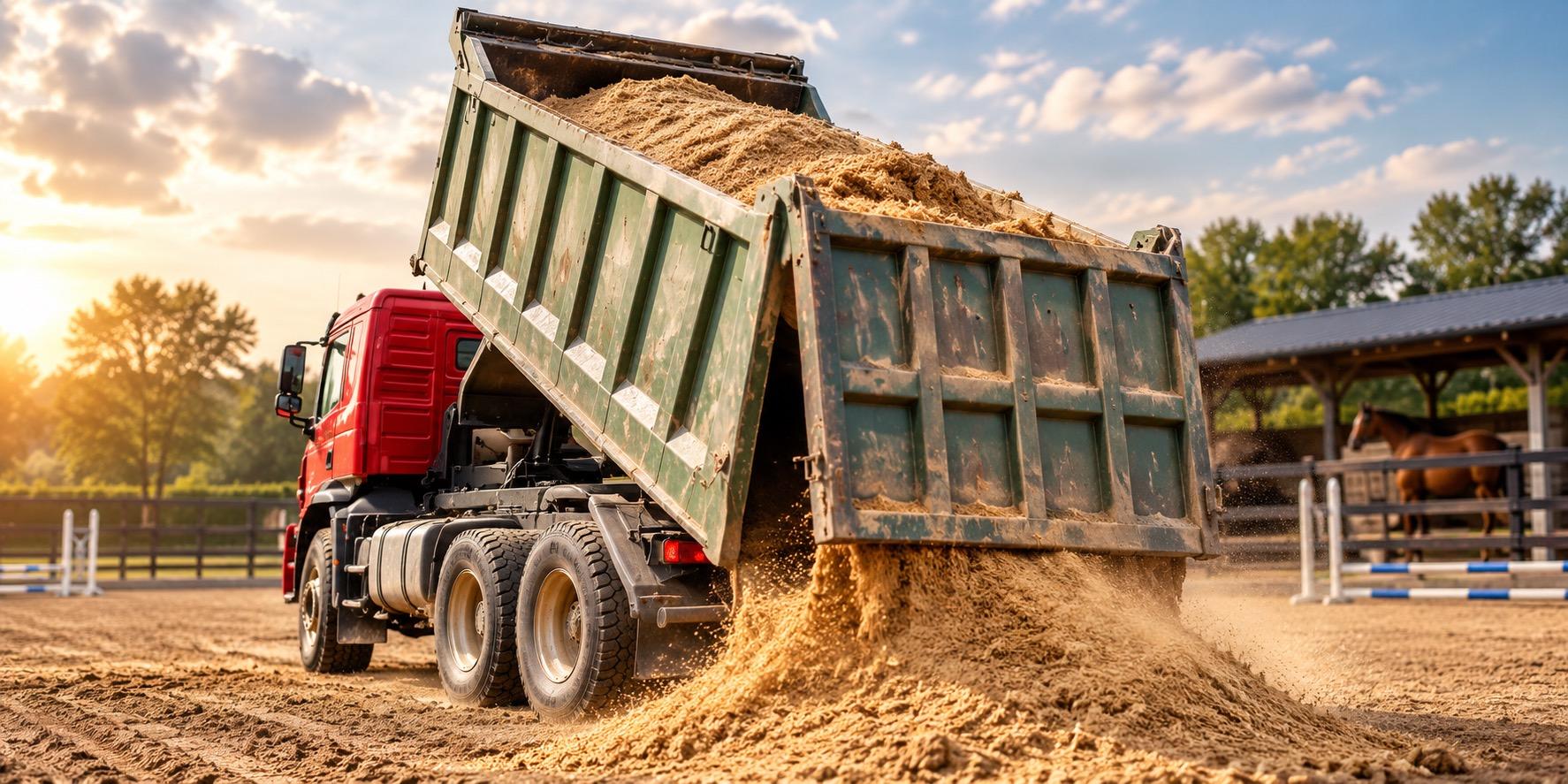
For most arenas it comes down to two: an end dump, which leaves one heap, and a belt truck, which can run it out low and slow as a long row the trade calls a windrow.

Bulk sand truck types, typical load, unloading method and best use
TruckTypical loadHow it unloadsBest for
Tandem / tri-axle dumpsmaller loadstips up at the backtight sites and small top-ups
End dumptractor + trailer~22 tonsthe trailer raises and the load slides out the back as one pilewhen you want a single stockpile
Belt truckalso called a live bottom~22 tonsA conveyor floor carries the sand out of the back at ground level, at the rate the driver setsputting the sand where you actually want it
Side dump22–34 tonstips sidewayshigh volume on open sites. The heaviest loads need extra axles

End dump

Has to rise to empty, so it needs clear sky above the dump spot and level ground under the wheels. Leaves one pile.

Belt truck

Never raises. A conveyor floor runs the sand out of the back at ground level, so the driver decides where it lands and how thick.

  • Tractor and trailer together run 65–70 ft. The trailer on its own is 28–40 ft.
  • Raising to unload is a tip-over risk on soft or uneven ground, as well as an overhead one.
  • A belt truck is slower to empty than an end dump, and the belt is machinery. Wet or sticky material slows it further.

The load count

How many loads you’ll need.

Almost nobody gets their arena in one truck. A full-size 100 × 200 ft arena takes 12–14 of them.

TONS OF SAND, AND WHAT THAT IS IN TRUCKLOADSONE TRUCKLOAD ≈ 18–22 TONS60 × 120 FTPRIVATE90 T · 5 LOADS20 × 40 MSMALL DRESSAGE108 T · 5–7 LOADS20 × 60 MSTD DRESSAGE163 T · 8–10 LOADS100 × 200 FTFULL SIZE250 T · 12–14 LOADS150 × 300 FTSHOW ARENA563 T · 26–32 LOADS0200400600TONS · EVERY ROW AT 3 IN DEEP
The bracket at the top is one truckload wide. Count it along a bar.
Tons and truckloads of arena sand by arena size, figured at 3 inches deep
Arena sizeSquare feetCubic feetTonsTruckloads
60 × 120 ftprivate arena7,2001,800905
20 × 40 msmall dressage8,6462,1621085–7
20 × 60 mstandard dressage13,0023,2511638–10
100 × 200 ftfull size20,0005,00025012–14
150 × 300 ftshow arena45,00011,25056326–32
Depth
Every row figured at 3 inches, the middle of the 2–4 inch band. Change it and every number moves.
Density
Every row uses the trade’s flat rate, 100 lb per cubic foot of dry sand, with nothing added for settling. Tons are cubic feet × 100 ÷ 2,000.
Load size
18–22 tons per truck and trailer is a planning figure for the rigs that reach most arenas, not the ceiling. The table above shows individual trucks running higher; site access decides which one turns up, and that is why the loads column is a range.

What moves the freight on a sand job.

We quote against a specific quarry and a specific lane, so there is no honest number to publish here. Four things decide it.

01

distance to the quarry

Often the biggest line on a sand job. Miles between a suitable quarry and your arena move it most.

02

how many loads

Tonnage divided by what a truck can legally carry. Every load is a round trip.

03

truck type

What your site can physically take, which is not always the most efficient truck for the tonnage.

04

how hard the site is

Tight access, a long crawl in, or a hard-surface drop and a second move.

Site access

Can a truck actually reach you?

Four things decide it, and you can check all four yourself in ten minutes with a tape measure.

Do it before you order, not on the morning.

PLAN: THE ROUTE IN12 FT MIN WIDTHNARROWEST POINT65–70 FTCOMBINATIONTURNING ROOMSECTION: THE SKY ABOVE IT14 FT MINTO DRIVE THE ROUTEA RAISED END DUMPSTANDS 25 FT AND UP
Two of the four are tape-measure numbers. The other two are ground and turning room.
01

twelve feet of width

Measure the narrowest point of the route, not the widest.

Gate posts, a pinch between two buildings, a tree grown into the lane. The tightest spot decides it.

02

fourteen feet overhead

Power and phone lines, low branches, gate arches, barn eaves.

That 14 ft gets the truck in. An end dump must raise to empty, and raised it stands 25 ft and up, so the dump spot needs more sky than the route. A belt truck never raises, which is the way around it.

03

ground that carries it

A loaded truck weighs 70,000–80,000 lbs.

Freshly watered or rained-on ground will not hold that, and neither will fresh fill. If it is marginal, we drop on hard standing.

04

room to turn around

The driver has to get out again.

A dead end means backing a 65–70 ft combination the whole way. Some drivers will refuse, and fairly so.

Also worth walking for: power lines, low branches, narrow gates, soft ground, tight turns. If any is borderline, tell us and we’ll pick the truck around it.

Call (704) 310-6238
ROAD811, 48 HRS AHEADBARNARENAMARK THE DUMP SPOTSEPTIC + LEACH: FLAG ITIRRIGATION: FLAG IT811 MARKS THE PUBLIC LINES. WHAT IS YOURS, YOU MARK.
Everything on this plan is on the checklist below.

The day before

Getting ready for delivery day.

Five things. None take long, and each prevents a problem that costs real money afterwards.

  1. 01

    mark the dump spot

    Cones or flags, before the truck arrives. A driver who has to guess puts the sand where it is easiest, not where you need it.

  2. 02

    clear the route

    Move vehicles and equipment off the lane, and trim overhanging branches. Anything you would rather a 65 ft truck did not touch, move it the day before.

  3. 03

    call 811 a few working days ahead

    Free, and it gets the public utilities marked before anything heavy drives over them. Most states want two or three working days of notice.

  4. 04

    flag your own buried lines

    811 does not mark what is yours. Septic tank, leach field, irrigation, shallow water, electric runs to the barn. Flag them all.

  5. 05

    have someone on site who can decide

    Not a voicemail. Somebody who can say “put it there instead” when the driver looks at the ground and does not like it.

Honestly

What can go wrong.

Four things account for nearly every bad delivery day. All four are predictable. Which is why we ask what we ask before booking.

GROUND THAT WON'T CARRY IT70–80K LBS LOADEDRAINED ON, OR WATERED YESTERDAYTHE FALLBACKDROP ON HARD STANDINGMOVE IT IN AFTERWARDS, A SECOND HANDLING
Weight is what finds soft ground. The fallback costs a second handling.

the ground is softer than it looked

Rain overnight, or the arena watered yesterday, and the ground will not take 70,000–80,000 lbs.

We check the forecast against the window and pick a hard-surface drop when it is close.

the truck can’t get in

A gate at eleven feet, a branch at twelve, a turn the trailer cannot make.

We ask for width, overhead and turning room before booking, so the truck matches the site.

nobody is there to make the call

The driver reaches a decision point, has nobody to ask, and either guesses or leaves.

One person on site with authority to move the dump spot solves it.

the wrong truck for the job

An end dump where there is no overhead room, or one asked to raise on ground that will not hold it.

Truck type is a decision, not a detail. It changes the work left afterwards.

The decision worth making

One pile, or a long row?

This is the choice that changes your day, and hardly anyone is asked about it before the truck is booked.

END DUMP: ONE PILE≈ 22 TONS IN ONE PLACEWHAT'S LEFT: HAULINGBELT TRUCK: A WINDROW≈ 22 TONS, ALREADY ALONG THE RUNWHAT'S LEFT: LEVELLING
Looking down on the arena. Same sand, two completely different Mondays.
≈ 22 tons

an end dump leaves a heap

The trailer raises and the load slides out in one place. Wanted a stockpile? Exactly right. Wanted it in the arena? Every ton moves again.

≈ 22 tons

a belt truck lays a windrow

The belt runs sand out of the back while the truck drives, so it lands as a long low row. Not spread and not to depth, but already along the run.

It is a labor decision far more than a material one.

take the belt truck when
A truck can safely drive the length of the arena, or there is no room overhead to raise a trailer at the dump spot.
take the end dump when
Access is tight, or you want the sand held in one stockpile until you and your contractor are ready for it.

Asked before every delivery

Delivery questions.

Worried about something on your site? Give us a call and describe it.

It depends on the truck. An end dump trailer carries about 22 tons, and a belt truck carries much the same. A side dump runs 22 to 34 tons depending on its axle count.

A tandem or tri-axle carries less, and suits tight sites and top-ups.

Most arenas need several. A 60 by 120 ft arena at 3 inches deep is 90 tons, about 5 loads. A full-size 100 by 200 ft arena is 250 tons, or 12–14 loads.

The tonnage is figured at a flat 100 lb per cubic foot; the load count moves with which truck turns up.

An end dump raises the front of its trailer and the whole load slides out the back in one pile. A belt truck never raises.

A conveyor floor carries the sand out of the back at ground level, as fast or as slow as the driver wants.

So one hands you a stockpile to move, and the other lets you choose: a long low row down the length of the arena, or a pile where you point.

You need about 12 feet of width and 14 feet of overhead along the whole route, plus firm ground and somewhere to turn around.

The dump spot is a separate question: an end dump has to raise to empty and stands 25 ft and up doing it, while a belt truck never leaves the ground.

An end dump and trailer runs 65–70 feet, so the turn at the end matters as much as the width getting in. Measure the narrowest point and the lowest branch.

A loaded truck weighs 70,000–80,000 lbs, and the sand alone is more than half of it. That weight is what finds soft ground, shallow irrigation lines and septic tanks.

Flag anything buried, and call 811 a few working days ahead for the public utilities.

If the route or the dump spot is questionable, we drop on a hard surface and move it in from there.

The truck unloads itself: an end dump tips it out the back, a belt truck runs it out on the conveyor. Nobody shovels anything off the truck.

Getting it from there into the arena and spread to depth falls to you or your contractor, which is why truck choice matters.

Somebody does. Not necessarily you, but a person on site who can decide: move the dump spot, wave the truck off wet ground, point at the second pile.

Deliveries go wrong most often when there is nobody to ask.

Dump on a hard surface, such as a driveway, a pad or an apron, and move the sand in with a tractor or skid steer once things dry out.

It costs a second handling, and it is far cheaper than a loaded truck sunk in your paddock.

Still working it out? The tonnage calculator gives tons and loads; the depth by discipline table gives the depth to run.

Free quote · by phone

Not sure a truck can reach your arena?

Call and describe it. The lane, the gate, the branch, the ground.

We’ll tell you which truck fits and how many loads it takes. If your site needs a different approach, we’ll say so on the phone.

Call (704) 310-6238