Skip to content

Arena footing · every discipline

Get your footing right the first time.

Dusty, packing hard, riding deep in one corner? The sand underneath is usually why. We work out what your arena needs and get it there.

what we look at
Grain shape, size band, gradation, mineralogy
what sets your depth
Discipline, traffic, indoor or out
where we start
The sand. By weight it is nearly all of the surface

Nationwide sourcing and delivery of equestrian materials

Most people find out they bought the wrong sand about six months in.

Four things we hear every week. Every one is a sand problem, none of them needs guessing at, and none of them gets better on its own.

You water it every day

and it is dusty again by lunchtime.

It sets like a road

then goes loose in patches after rain.

One corner rides deep

the other rides hard, same arena.

Something feels off

the horse is not moving the way it was, and nothing else changed.

sand comes first

We spec the sand before anything gets blended into it.

no quarry loyalty

We aren’t owned by a pit, so we recommend the sand that fits.

matched to your riding

Discipline, traffic and climate set the spec, not a catalog.

you don’t chase quarries

We work out the spec and find the source. You never have to read a gradation report.

The part that decides everything

Grain shape is the whole argument.

Think of it like gravel versus marbles. Marbles roll out from under you. Broken gravel locks together so hard it turns into pavement. What you actually want sits between the two.

That middle ground is sub-angular sand. Grains whose sharp edges have been worn off just enough to nest together without packing solid. Get this wrong and no amount of watering, dragging or additive will save the surface.

Round

Cushions well. Rolls like ball bearings under a hoof, so traction and stability suffer.

too loose alone

Sub-angular

Edges worn down enough to nest and hold, loose enough to keep moving. Traction without compaction.

what you want

Angular

Sharp faces lock together for grip, then keep locking. Compacts toward concrete over time.

too hard alone

FOOTING LAYER: THE SAND. THIS IS WHERE WE START.BASECOMPACTED SUB-BASE2"–4"

Where we start

Get the sand right and the rest gets easier.

Plenty of arenas get a fiber, a mat and a groomer specified before anyone has looked at the sand. Fiber gets blended into that sand, so the sand decides how the fiber behaves.

By weight the sand is nearly all of that surface, so we start there and let it set what the rest needs to do.

Free · no email required

How much sand does your arena need?

Set your dimensions and depth. You’ll get tons and truckloads, worked at the trade’s flat rate of 100 lb per cubic foot. Worked examples and the math behind it.

Your arena

What you'll need

250 tons of sand. 5,000 cubic feet. 12 to 14 truckloads.

tons of sand
truckloads
cubic feet
Riding surface
20,000 sq ft
Footing depth
3"
Volume
5,000 cu ft
Density, flat rate
100 lb / cu ft
Weight
500,000 lb

Tons = cubic feet × 100 lb ÷ 2,000, nothing added for settling · loads on a 18–22 ton truck

Specs by discipline

A cutting pen is not a dressage court.

Most suppliers ask what you ride, then answer privately by email. Here’s the table.

  • Dressage2"–3"

    Finer, sub-angular

    Continuous repetitive loading on the same hoof patterns. Wants cohesion and a firm, uniform surface that supports collection.

  • Hunter / Jumper3"–4"

    Medium, sub-angular

    Needs cushion and rebound on landing without going deep enough to strain a tendon on takeoff.

  • Reining3"–5"

    Medium, over a firm base

    The slide comes from a base that does not give, not from a thin surface. Enough material to protect the stop, carried on a base compacted hard underneath it.

  • Barrel Racing4"–5"

    Coarser, looser

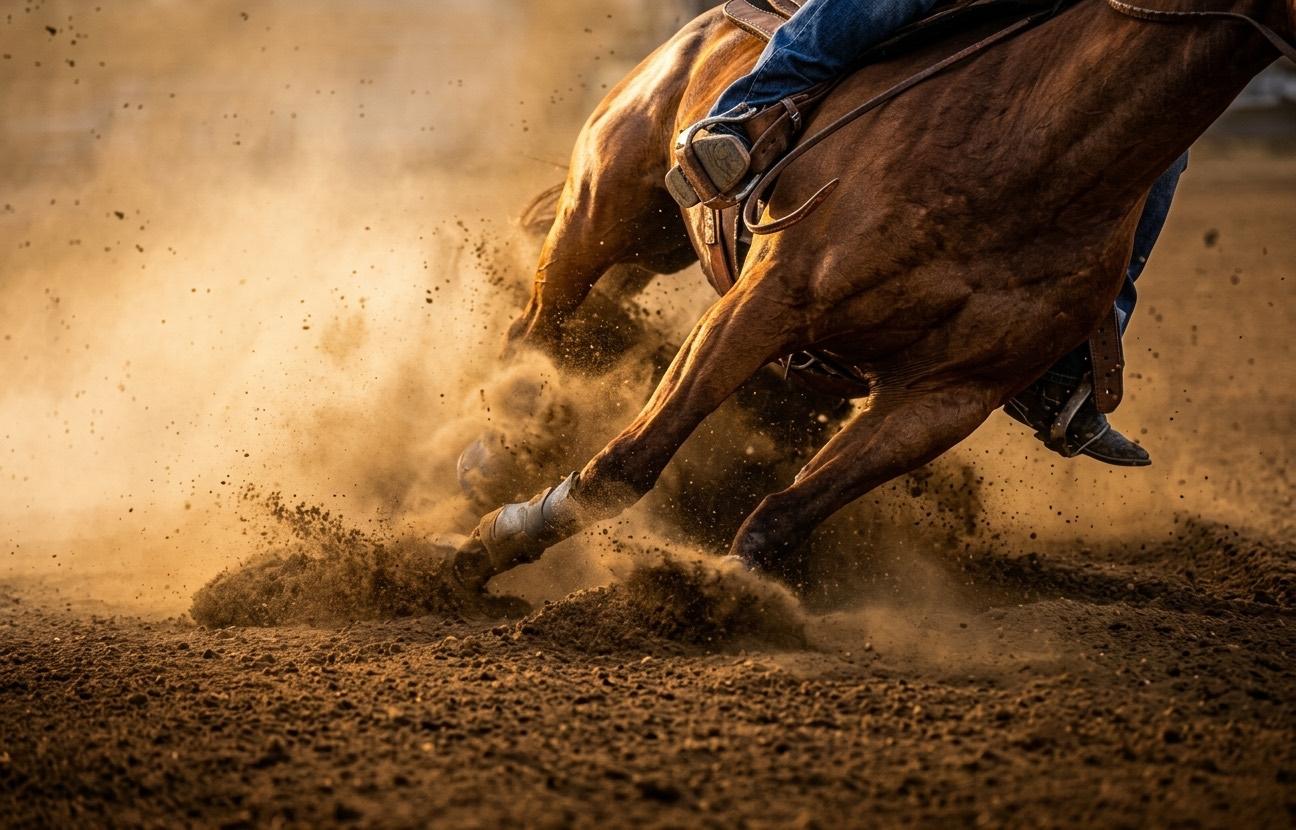
    Hard, sharp turns at speed. Depth protects the joints through the turn.

  • Cutting4"–6"

    Coarse, deep

    Deepest common surface. Protects through rapid direction changes and hard stops.

  • Roping3"–4"

    Medium

    Balance of grip for the run and cushion for the stop.

  • Trail / Pleasure2"–4"

    Medium, sub-angular

    Lower traffic and lower impact. Consistency matters more than cushion.

  • Multi-use3"–4"

    Medium, sub-angular

    The compromise surface. Set it in the middle rather than to the deepest user. Footing specified for cutting is too deep for the dressage and jumper horses sharing the arena.

These are the working ranges we spec to, not a published standard. No authority publishes depth by discipline. The method underneath them is Penn State Extension’s: start shallow, add in half-inch increments. Exact gradation is set against the specific sand we source for you.

How it works

What happens when you call us.

No form to fill in first, no quote portal, no waiting on an email. You describe the arena and we start working on it.

01

tell us about your arena

Size, discipline, how much you ride, indoor or out, and what the surface does wrong today.

02

we write the spec

Grain shape, size band, gradation and depth for your conditions, not a generic recommendation.

03

we find the source

We work our quarry network to find material that meets that spec as close to you as possible. Freight distance is usually the biggest cost on the job.

04

it gets delivered

We coordinate the loads, the timing and the site access, and tell you how to be ready for the truck.

Before you buy

Four ways people get sold the wrong sand.

None of these involve anyone lying to you. That’s what makes them expensive.

  1. 01

    they buy a name, not a spec

    “Masonry sand” and “concrete sand” describe what the material was graded for, not how it behaves under a horse. The name travels. The properties don't.

  2. 02

    they buy whatever is closest

    Freight is real money, so the nearest pile wins by default. Sometimes that pile is right. Nobody checks.

  3. 03

    they specify it backwards

    A fiber, a mat or a groomer gets chosen first, and the sand becomes an afterthought. Fiber is blended into the sand, not laid over it, and the sand it goes into is most of the surface, so it has to be the first decision, not the last.

  4. 04

    they skip the gradation report

    Every reputable quarry has one. Most buyers never ask, and find out what they bought about six months in.

Questions we get every week

Straight answers.

If yours isn’t here, give us a call. We’d rather talk it through than have you guess.

A full-size 100 × 200 ft arena at 3 inches deep is 250 tons, about 12–14 truckloads. A 60 × 120 ft private arena at the same depth is 90 tons, or 5 loads.

Both are figured at a flat 100 lb per cubic foot, with nothing added for settling.

Most arenas land between 2 and 4 inches. Penn State Extension recommends starting at 2 inches and adding in half-inch increments until it rides right.

That advice is worth following, because taking sand out is far harder than putting more in. Published guidance advises against going past about 6 inches, because of the strain deep footing places on tendons.

Washed, screened, sub-angular silica sand with a low percentage of fines. Those are separate properties, and a good arena sand has all of them.

Sub-angular grains nest together enough to give traction without packing like fully angular sand. Washing and screening keep the fines low, so the surface drains and does not turn to dust.

Quartz resists breaking down under hoof concussion. Beyond that it depends on your discipline, your climate and how much you ride. That is the part no chart can answer for you.

Usually not, and this is the single most expensive mistake in arena building. Those names describe what the sand was graded for, not how it behaves under a horse.

There is no such thing as a universal 'arena sand'.

Nobody keeps a register of sand names in the US, the trade's own estimate runs past 10,000, and only a narrow band of them belong in a riding arena.

Three usual causes. The sand is breaking down under hoof concussion into particles fine enough to go airborne. Or it was never properly washed and still carries clay, silt or organic material.

Or your base is migrating up through the footing. Dust is usually a sand problem before it is a watering problem, which is why the fix starts with knowing what you actually have.

It depends on far more than the sand. Freight is frequently the largest line on the invoice, so the distance between you and a suitable quarry usually matters more than the material itself.

Tonnage, truck type, site access and whether the sand needs washing or screening all move the number. We'll give you a real figure once we know where you are and what you need.

We source nationwide. We don't own quarries or trucks.

What we do is know which sands work, which quarries have them, and how to get the right material to your arena without you having to translate a gradation report yourself.

Free quote · no obligation

Tell us about your arena. We’ll tell you what it needs.

Start with a call. We’ll work out the right spec for how you ride, then find the closest source that carries it.

If the sand you already have is fine, we’ll say so rather than sell you a load you don’t need.

(704) 310-6238

Straight through to someone who knows sand

Handy to have ready

  • roughly how big the arena is
  • what you ride, and how often
  • what it does wrong now: dusty, hard, deep, holds water
  • whether a truck can get to it

Don’t have all of it? Call anyway. Most people don’t know their numbers when they call, and that’s genuinely fine.

Call (704) 310-6238